
Strategies to Minimize the Adverse Effects of Shiftwork

Dr. Maryam Mirhadi, PMP, PSP

Shiftwork is defined as working other than daytime hours. Shiftwork is the most commonly utilized alternative to overtime. Despite its potential benefits in accelerating a construction schedule, shiftwork is considered among the factors with adverse effects on labor productivity in construction.

Some of the key issues with shiftwork include its adverse effect on circadian rhythms, dilution of supervision, challenges in exchanging performance information among individuals who work in different shifts, the adverse effects of shiftwork on social interactions, and higher work setup times. A number of studies address the adverse effects of shiftwork on productivity. Some of the key studies include the Bureau of Labor Statistics, the Business Roundtable, NECA 1969 study, the Construction Industry Institute (CII), and the works of Hanna et al. (2008 and 2009). The American Association for Cost Engineering (AACE) has identified some of the recommended specialized studies that can be used to evaluate the adverse effects of shiftwork on productivity (AACE, 2004).

Despite these negative effects, construction contractors use shiftwork as a way to accelerate construction schedules. But the question is what strategies are effective in minimizing the adverse effects of shiftwork on construction work. Some of these strategies include the following:

1- Refrain from shiftwork for those who are more susceptible to health problems: Construction contractors should refrain from scheduling shiftwork for those employees who are susceptible to health problems. Workers older than 50 years or pregnant women are examples of these individuals.

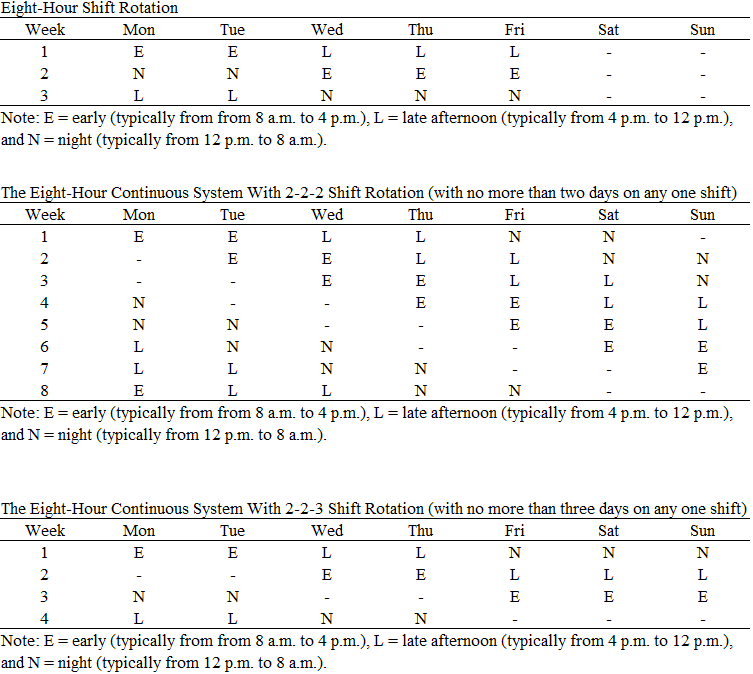
2- Use rapid rotations: Instead of weekly or monthly cycles, construction contractors are encouraged to consider rapid rotations in scheduling shiftwork. The use of rapid rotations in scheduling shiftwork is recommended because rapid rotations do not significantly disrupt sleep patterns of those individuals who work on a shiftwork basis. Three examples of rapid rotation shiftwork systems are shown in the following tables (Kodak, 1986):
3- Overlap consecutive shifts in part: By providing some overlap between consecutive shifts, construction contractors can overcome the challenges in exchanging performance information among individuals who work in consecutive shifts. That way, the arriving crews become aware of what has been performed by the previous crews. To achieve this objective, construction contractors can ask the foreman of the first shift to stay one or two hours longer or the foreman of the arriving crews to arrive earlier to the extent practically needed for coordination purposes.

4- Assign independent tasks to consecutive shifts: Different shift-working teams tend to work with the same set of tools, machinery, and equipment; therefore, work setup times are typically higher when multiple teams (instead of one team) use the same set of tools, machinery, and equipment. In addition, extra time is needed in shiftwork for the process of hand-over and transition from one shift to another if the work of consecutive shift are dependent. To overcome these challenges, construction contractors can assign tasks that are totally independent from the tasks performed by the previous shift to minimize the interdependency of shifts and reduce the materials and tools that are commonly used by two consecutive shifts.

5- Properly select the work assigned to a second shift: Construction contractors should assign to shiftwork only tasks that are on the project critical path or those work elements that are justified to be accelerated. Proper selection of work assigned to a second shift also includes assigning tasks that are less demanding from the supervision or engineering support perspectives to ensure progress can be made without waiting for supervision or engineering support that may not be readily available during shiftwork periods.

6- Make proper work environment accommodations: Since shiftwork is performed in hours other than daytime hours, work environment considerations need to be identified. Examples include natural lighting vs. artificial lighting and additional demands for air conditioning. Studies have shown that safety is significantly improved by providing an adequate amount of artificial lighting. Moreover, working in places in which work environmental considerations have been taken into account help employees work in a more efficient and effective manner.

 In sum, despite the negative effects of shiftwork, construction contractors use shiftwork as a way to accelerate construction schedules. Nevertheless, construction contractors are recommended to use effective strategies to minimize the adverse effects of shiftwork on construction work. Examples of these strategies include refraining from shiftwork for those who are more susceptible to health problems, using rapid rotations, overlapping consecutive shifts in part, assigning independent tasks to consecutive shifts, properly selecting the work assigned to a second shift, and making proper work environment accommodations.

References:

AACE International (2004), Recommended Practice 25R-03 Estimating Lost Labor Productivity in Construction Claims, AACE International, Morgantown, WV. Can be retrieved from https://web.aacei.org/docs/default-source/toc/toc_25r-03.pdf?sfvrsn=4

Kodak, E. (1986). Ergonomic design for people at work. Volume, 2, 20-30.

Hanna, A. S., Chang, C. K., Sullivan, K. T., & Lackney, J. A. (2008). Impact of shift work on labor productivity for labor-intensive contractor. Journal of construction engineering and management, 134(3), 197-204. Can be retrieved from https://goo.gl/CPR9wm

Hanna, A. S., & Haddad, G. (2009). Overtime and productivity in electrical construction. In Construction Research Congress 2009: Building a Sustainable Future (pp. 171-180). Can be retrieved from https://ascelibrary.org/doi/abs/10.1061/41020(339)18


To learn more about the adverse effects of shiftwork on labor productivity, please read this article.

If you’d like to learn more about Adroit’s construction management services, call 1.352.327.8029 or contact us using this form.

Our posts to the Insights page share fresh insights and seasoned advice about many project and construction management topics.  To have the Insights monthly newsletter delivered automatically to your email inbox, please subscribe here.


 

Adverse effects of schedule deficiencies on claim administration

Dr. Maryam Mirhadi, PMP, PSP

Project schedules provide a basis for communication, execution, monitoring and controlling, and reporting and offer a platform for measuring project progress and performance. In addition, courts bank on project schedules to assess time extensions or time-related compensation requests. As such, project time schedules are one of the key inputs without which many construction claims cannot properly be prepared or investigated. Construction contractors should give proper attention to preparing detailed and reasonable project schedules throughout the project to ensure the project schedules remain acceptable and reliable over the course of the project, and they reasonably represent the plans as well as the actual progression of work. Some of the main issues with project schedules, especially those that adversely affect claim administration efforts, are discussed in this brief article.

The project schedule needs to be continuously updated at reasonably short time intervals; otherwise, project schedules will not reflect the most current information about the actual progression of work on the project. Inaccurate updated schedules and the lack of updated schedules for some of reporting/updating cycles make claim administration challenging because the updated schedules may not contain all pieces of information that a claim investigation team is looking to find. Examples of these pieces of information include planned start and finish dates, actual start and finish dates to quantify the extent of delays, periods of disruption, and the key dependencies that drive critical path delays within each updating cycle. In particular, delays cannot properly be assessed without having accurate project schedules for all the key reporting/updating cycles especially for the cycles in which delays have negatively impacted the progression of work.

Project schedules should not only represent the plans going forward but also illustrate the actual progression of work. In doing so, if an impact prevents a contractor from being able to achieve certain planned dates, these impacts should properly be reflected in the schedule. For instance, if during a time analysis period, a change has impacted a contractor’s work sequence, the project schedule updated at the updating cycle immediately after the change should properly illustrate the impact of this change on the work. Otherwise, retroactively correcting the project schedules may be challenging due to reasons such as lack of access to accurate contemporaneous data or lack of authorization to make changes after the fact. Project schedules also need to be complete to ensure they include a right set of project activities and work packages, properly reflect the project scope of work, and outline all reasonable steps that need to be taken to complete the project scope of work in its entirety.

Depending on the nature of the work, a proper combination of physical, safety, resource, and preferential relationships can be used in defining activity relationships. It is important, however, to make sure that project schedules are free of logic deficiencies. Example logic deficiencies that may call the credibility of project schedules into question include incorrect logic, missing logic, logic loops, excessive or improper use of time lags/leads, and redundant activity ties. Logic deficiencies make the process of delay analysis challenging because a schedule that suffers from logic deficiencies cannot reasonably be used to assess the expected and actual sequence of work.

Resource loading project schedules allows for resource planning, resource tracking, and resource optimization. It also allows for adjusting the schedule based on resource constraints by performing resource smoothing or resource leveling. In a similar way, cost loading project schedules allows for the development of funding plans, budget consumption plans, and cost flows. Resource plans and budgeted costs are also important for claim investigation purposes because they specify how resources and costs were supposed to be expended over the course of the project and identify if certain changes, delays, or productivity factors have impacted these schemes. As such, resource plans and budgeted costs should be prepared at a reasonably detailed level; otherwise, they cannot provide an insight into the impact of change on the project. Properly documenting the basis of estimates and using proper cost breakdown structures are two other important considerations in budget and cost flow documentation. Whenever, a delaying event occurs or a condition adversely influences the project schedule, the contractor should re-assess the project schedule to ensure the schedule is adequately detailed to measure the adverse effect of the delaying event or the condition with a negative impact on the project schedule.

Many factors play a role in the successful use of project schedules in administering construction claims. However, the quality of project schedules is one of the main role players in facilitating successful management and resolution of construction claims. The accuracy of project schedules, their completeness and reasonableness, and proper use of resource- and cost-loaded schedules are some of the important considerations that need to be given to using project schedules in administering construction claims.

—

Our posts to the Insights page share fresh insights and seasoned advice about many project and construction management topics.  To have the Insights monthly newsletter delivered automatically to your email inbox, please subscribe here.

Pricing Change Orders

Maryam Mirhadi, Ph.D, PMP

Owners typically have the contractual right to make changes to the scope of work outlined in contracts. Since these changes impact contracts’ scope of work and they potentially have time, cost, and productivity implications, it is important to give proper consideration to pricing change orders.

Pricing is either backward or forward. Backward pricing is used when the pricing is partly or wholly based on the actual cost of a work performed. Forward pricing, however, is based on the estimated cost of work that is yet to be performed. 

If the forward pricing approach is used to price change orders or change order requests, the estimated cost of work is prepared based on the projected cost of materials, systems, products and permanent equipment needed to execute the work plus the costs of resources that need to be acquired in implementing the scope of work. The first category of costs is associated with those items that remain as part of the facility or the system being implemented whereas the second category of costs referenced above is associated with project resources (including workforce, temporary equipment, tools, and machinery) that do not remain in the project but are necessary to accomplish project activities. It is recommended that practitioners differentiate between these two categories of costs to ensure the cost of project deliverables can be differentiated from the resource costs.

It is important to account for projected levels of productivity in pricing change orders because the resource usage rate needed to perform a changed work may differ from the resource usage rates required to implement a work under normal circumstances in which no change is introduced. For example, if changing a scope of work adversely impacts labor productivity, the estimated usage rate of workforce originally used to estimate the unimpacted work does not necessarily suffice to complete a changed (i.e., impacted) scope of work. As such, in pricing change orders, the effects of change on the original scope of work need to be assessed to adjust the estimates.

One of the techniques that can be effective in assessing the impact of a changed work is assessing the project cost flow. Cost flow and cash flow are often used interchangeably. It is important, however, to identify the purpose each of these tools intends to serve. A cost flow diagram shows the budgeted amount of money that is needed over time to make progress as planned. A cash flow diagram, on the other hand, provides the estimated sums of money to which a contractor has access over time.  Assessing the project cost flow can help analyze excessive costs and overruns by comparing the budgeted (i.e., time-phased estimates) cost of performing the changed work with the sums of money originally needed to make progress as planned. This assessment can help identify the adverse effect of the change on the resource costs needed over time.

This assessment can be insightful only if the cost flow and estimates are prepared at a sufficiently detailed level. Otherwise, they cannot provide an insight into the impact of change because of the lack of granularity of the pricing data available. Properly documenting the basis of estimates and using proper cost breakdown structures are two other important considerations in budget and cost flow documentation. Detailed budgets or cost flows are prepared by relying on certain assumptions and information available at the time of preparing these estimates. These assumptions and information should properly be documented in a document, entitled “basis of estimate”, for future references.

Per the Federal Acquisition Regulation (FAR), cost estimates used in government contracts have to be reasonable, allocable, and allowable. Moreover, pricing data must be current, accurate and complete. The following excerpts from the FAR define reasonableness, allocability, and allowability of costs:

  1. In defining the reasonableness of costs, Provision 31.201-3 of FAR states:

A cost is reasonable if, in its nature and amount, it does not exceed that which would be incurred by a prudent person in the conduct of a competitive business.

  1. In defining the allocability of costs, Provision 31.201-4 of FAR states:

A cost is allocable if it is assignable or chargeable to one or more cost objectives on the basis of relative benefits received or other equitable relationship.

Per the FAR, a cost is allocable only if it:

(a) is incurred specifically for the contract; (b) benefits both the contract and other work, and can be distributed to them in reasonable proportion to the benefits received; or (c) is necessary to the overall operation of the business, although a direct relationship to any particular cost objective cannot be shown.

  1. Per the FAR, the factors that need to be considered in determining whether a cost is allowable include the following:
  • Reasonableness
  • Allocability
  • Standards promulgated by the CAS Board, if applicable; otherwise generally accepted accounting principles and practices appropriate to the particular circumstances.
  • Terms of the contract
  • Any limitations set forth in this subpart

It is also important to differentiate between direct and indirect costs in pricing change orders and determine which types of direct or indirect costs have to be included to accurately prepare cost estimates. Typical direct costs of executing construction activities include direct labor and workforce, equipment, material, and services provided to each project activity. Direct costs can be assigned to specific project activities whereas indirect costs are intended to cover overhead expenses that are needed to manage, administer and support the work. Indirect costs are not typically assignable to particular project activities. General conditions costs support various aspects of the work and they are typically assigned at the project level,  not at the activity level. Therefore, they are typically considered among the indirect costs unless a different definition of indirect costs is adopted.

Based on what was discussed above, it is important to give proper consideration to pricing change orders. The proper use of pricing approaches including backward or forward pricing is the first step towards properly pricing change orders. The other considerations is to identify the time, cost, and productivity impacts of changes on the original scope of work. Cost flow diagrams can assist in better identifying the impact of change on a project cost, schedule, and productivity. It is also important to ensure proper pricing and estimating practices are used to ensure estimates are reasonable, allocable, and allowable. An effective use of cost engineering techniques throughout the process plays an important role to ensure the estimates prepared for change orders are current, accurate and complete.

—

Our posts to the Insights page share fresh insights and seasoned advice about many project and construction management topics.  To have the Insights monthly newsletter delivered automatically to your email inbox, please subscribe here.

Adroit’s Experts are the Two Recipients of the AACE International 2018 Technical Excellence Award

Adroit is proud to announce that AACE International (the Association for the Advancement of Cost Engineering) has awarded its 2018 Technical Excellence Award to Dr. Maryam Mirhadi and Dr. Amin Terouhid, two of Adroit’s principal consultants.  This award is given by the AACE International to recognize outstanding technical contributions to the Association in the project and cost management community. Technical excellence may be accomplished through significant achievement or contribution to technical division work or administration and by playing an instrumental part in the development of technical products.

Dr. Mirhadi and Dr. Terouhid have received this award, in part, because of their role in authoring three Recommended Practices (RPs) including RP91R-16 Schedule Development, RP 92R-17 Analyzing Near-Critical paths, and RP89R-16 Management Summary Schedule. Excerpt of these RPs can be found on the AACE International website at this address: https://web.aacei.org/resources/publications/recommended-practices

The AACE International Recommended Practices are intended to be the main technical foundation of our educational, and certification products and services. The RPs are a series of documents that contain valuable reference information that has been subject to a rigorous review process and recommended for use by the Technical Board.

With 7,000 members in 100 countries, AACE International has been serving the total cost management community since 1956. AACE is committed to the constructive exchange of ideas between members, development of technical guidance and quality education and recognition of subject matter experts.

Adroit will be providing a training seminar at the 2018 AACE International Conference & Expo

Adroit will be providing the following training seminar at the 2018 AACE International Conference & Expo in San Diego, CA on June 27 and June 28, 2018: Managing a Project from A to Z – A Methodology Based on Key AACE Recommended Practices.

This seminar provides a project management methodology based on a select set of AACE recommended practices. This methodology identifies the key process steps in managing projects and specifies the tools that can be used in each step for successfully using the methodology in managing real-world projects. With its novel approach, the seminar explores how work breakdown structures need to be developed, and how these structures can effectively be used to produce the list of project activities. The attendees will then practice developing and managing a project schedule based on the key requirements outlined in the corresponding recommended practices. Other topic areas include project cost estimating, project risk management and project execution. With its focus on the AACE Recommended Practices, the seminar reviews the relevant recommended practices in each step of the methodology and provides a variety of examples to effectively use content knowledge and relevant skills in teaching the concepts.

The course material contains both tutorials and example-based exercises. To enable educational training and learning objectives to be planned and measured properly, exercises will specifically target each of the learning objectives outlined above. Additionally, the assessment questions will be created such that they correlate with the seminar learning objectives. More information about the content of this educational seminar is provided below:

Learning Objectives and Method of Measurement

  • Apply a proposed project management methodology that can be used for effective management of real-world projects
  • Identify the key process steps in implementing real-world projects and the tools and techniques that can effectively be used in practice
  • Identify the key AACE recommended practices that relate to each process step to demonstrate an in-depth knowledge of the key requirements of each recommended practice

Knowledge Areas Addressed
Project Time Management, Project Cost Management, Project Risk Management, and Project Control and Project Control Process

Agenda

Day 1

Develop process- and deliverable-oriented Work Breakdown Structures (WBS)

  • AACE International Recommended Practice 33R-15 Developing the Project Work Breakdown Structure
  • AACE International Recommended Practice 39R-06 Project Planning – As Applied in Engineering and Construction for Capital Projects

Develop Organizational Breakdown Structure (OBS) and Responsibility Matrix

  • AACE International Recommended Practice 83R-13 Organizational Breakdown Structure and Responsibility Assignment Matrix

Produce the Activity List based on the process- and deliverable-oriented WBS’s

  • AACE International Recommended Practice 23R-02 Identification of Activities
  • AACE International Recommended Practice 37R-06 Schedule Levels of Detail—As Applied in Engineering, Procurement, and Construction
  • AACE International Recommended Practice 32R-04 Determining Activity Durations

Develop the project schedule 

  • AACE International Recommended Practice 24R-03 Developing Activity Logic
  • AACE International Recommended Practice 61R-10 Schedule Design – As Applied in Engineering, Procurement, and Construction
  • AACE International Recommended Practice 48R-06 Schedule Constructability Review
  • AACE International Recommended Practice 38R-06 Documenting the Schedule Basis

Day 2

Manage the project schedule

  • AACE International Recommended Practice 53R-06 Schedule Update Review – As Applied in Engineering, Procurement and Construction
  • AACE International Recommended Practice 54R-07 Recovery Scheduling—As Applied in Engineering, Procurement, and Construction
  • AACE International Recommended Practice 49R-06 Identifying the Critical Path
  • AACE International Recommended Practice 92R-17 Analyzing Near-Critical Paths

Prepare project cost estimates 

  • AACE International Recommended Practice 18R-97 Cost Estimate Classification System
  • AACE International Recommended Practice 19R-97 Estimate Preparation Costs in the Process Industries
  • AACE International Recommended Practice 40R-08 Contingency Estimating – General Principles
  • AACE International Recommended Practice 34R-05 Basis of Estimate 

Manage project risks

  • AACE International Recommended Practice 72R-12 Developing a Project Risk Management Plan
  • AACE International Recommended Practice 57R-09 Integrated Cost and Schedule Risk Analysis Using Monte Carlo Simulation of a CPM Model
  • AACE International Recommended Practice 62R-11 Risk Assessment: Identification and Qualitative Analysis
  • AACE International Recommended Practice 63R-11 Risk Treatment

Execute the project and use   project control techniques

  • AACE International Recommended Practice 55R-09 Analyzing S-Curves
  • AACE International Recommended Practice 60R-10 Developing the Project Controls Plan
  • AACE International Recommended Practice 82R-13 Earned Value Management (EVM) Overview and Recommended Practices Consistent with EIA-748-C
  • AACE International Recommended Practice 86R-14 Variance Analysis and Reporting


Instructor: Dr.  Amin Terouhid, PMP, DRMP, PSP
Dr. Terouhid is Adroit is a principal consultant at Adroit Consultants, LLC. He has a master’s degree in industrial engineering and another master’s degree in civil engineering. With a Ph.D. in construction management, Dr. Terouhid’s expertise is focused on project planning and scheduling, construction claim analysis, and cost engineering.  As an expert, Dr. Terouhid has provided consulting services to a wide range of clients for more than 14   years especially in the gas, petrochemical, and construction industries.

He also has extensive teaching and research experience in the fields of operations, project, and construction management. He is the primary author of three AACE recommended practices (RP 89R-16, RP92R-17, and 91R-16), and has published a variety of articles, with a focus on construction management, in scientific journals and presented his works in international conferences. He also holds Project Planning and Scheduling Professional (PSP), Decision and Risk Management Professional (DRMP), and Project Management Professional (PMP) certificates.

To find out more and register, please check out the following links:

https://web.aacei.org/resources/interactive-learning/seminars/conferenceexposeminars/d3-managing-a-project-from-a-to-z—a-methodology-based-on-key-aace-recommended-practices

https://web.aacei.org/resources/interactive-learning/seminars

Waiver language in contracts may obstruct recovery of damages

Dr. Maryam Mirhadi, PMP, PSPS

Project risks are treated in a variety of ways. Contract documents are among the key mechanisms that parties to a contract may use to transfer a risk to another party, accept a risk, or select other risk response strategies to treat the risk. The use of waiver language in contract documents is one way to achieve this objective. Waiver language is increasingly incorporated in various contract documents such as contracts, payment releases, and change order or directive forms. The intent of waiver or disclaimer language is to constrain a contractor’s entitlement to compensation for resultant damages that are not expressly identified as compensable in the executed change order.

Therefore, it is important that contractors closely examine contract documents to identify which risks they are taking by entering into a contract or by accepting to include certain waiver language in the contract documents. This close examination becomes more important if a contractor intends to reserve its right to seek compensation for resultant damages. One of the other reasons that highlight the importance of close examination of waiver language in contract documents is that the impact of some changes on a contractor’s productivity or performance is not readily apparent. In these cases, a contractor may be able to evaluate these damages or assess their actual cost impact only after executing the work. If so, it is likely that the contractor has already been asked to execute a variety of contact documents containing some form of waiver language. Therefore, contractors are generally advised to exercise caution to the extent possible and adjust the contract language to avoid unintended consequences.

One of the mechanisms to achieve this objective is to use conditional phrases. An example provision that uses a conditional phrase may be as follows:

The amount of the individual change is in full satisfaction of the changed work and the contractor waives any claim for further compensation for cumulative impact costs unless the contractor expressly reserves that right and no other change concurrently impacts the scope of work.

It is imperative that construction contractors seek legal and expert advice prior to executing contract forms that contain some types of a waiver or release language to determine the best strategies that can be used to avoid unintended consequences of waiver language to the extent possible. Contractors are typically advised to avoid executing overarching waiver provisions.

The second strategy that a contractor may choose to pursue if a client requires the contractor to sign a contract form with some types of overarching waiver or release language is to engage in bilaterally negotiations that aim to include alternative language or adjustments to language as appropriate. These alternative language or adjustments are project-specific conditions or language that the contractor creatively phrases to appear on the contract document or forms, and they may entitle the contractor to reserve, at a minimum, a portion of the contractor’s rights to recover proper damages under defined circumstances.

Accepting a unilateral change order that pays for most of the costs without signing the documents that contain overarching waiver language is another strategy that prudent contractors may pursue if the magnitude of consequential impacts justifies the use of this strategy.

If the contract permits the contractor to carry out the changed work without a settled change order, the fourth strategy that contractors may choose to pursue instead of executing documents that contain overarching waiver language is to complete the work without formally signing the change order form and at the same time use the capacities of the contact dispute clause to seek payments to the extent contractually allowed. 

Prudent contractors should closely examine contract documents to identify which risks they are taking by entering into a contract or by accepting to include certain waiver language in the contract documents. They are also advised to use any of the four main strategies discussed above if they are asked to execute forms that contain overarching waiver language to avoid the negative risks of waiver and release language and mitigate their potential impact to the extent practically feasible.

—

Our posts to the Insights page share fresh insights and seasoned advice about many project and construction management topics.  To have the Insights monthly newsletter delivered automatically to your email inbox, please subscribe here.

Common mistakes concerning project risks

Maryam Mirhadi, Ph.D., PMP, PSP

Project risks are uncertain events or conditions that may impact a project if they occur. It is important to note that this impact may be negative or positive. As such, project risk response strategies have to be used to deal with each of the project risks. Different risk response strategies may be used depending on whether the risk is negative or positive. Negative risks pose a threat; however, positive risks are to be treated as opportunities.

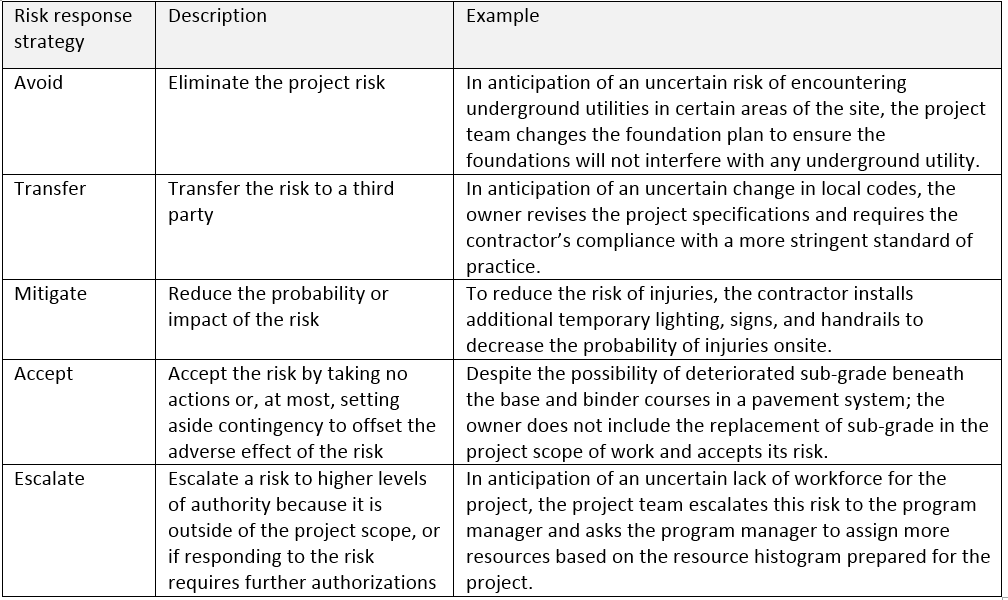
A Guide to the Project Management Body of Knowledge (PMBOK® Guide) –Sixth Edition, identifies the following as the five risk response strategies that can be used for managing negative project risks: avoidance, transference, mitigation, escalation, and acceptance strategies (PMI, 2017). The following table provides a short description and example for each of these risk response strategies:

Table 1. Risk-response strategies for managing negative risks


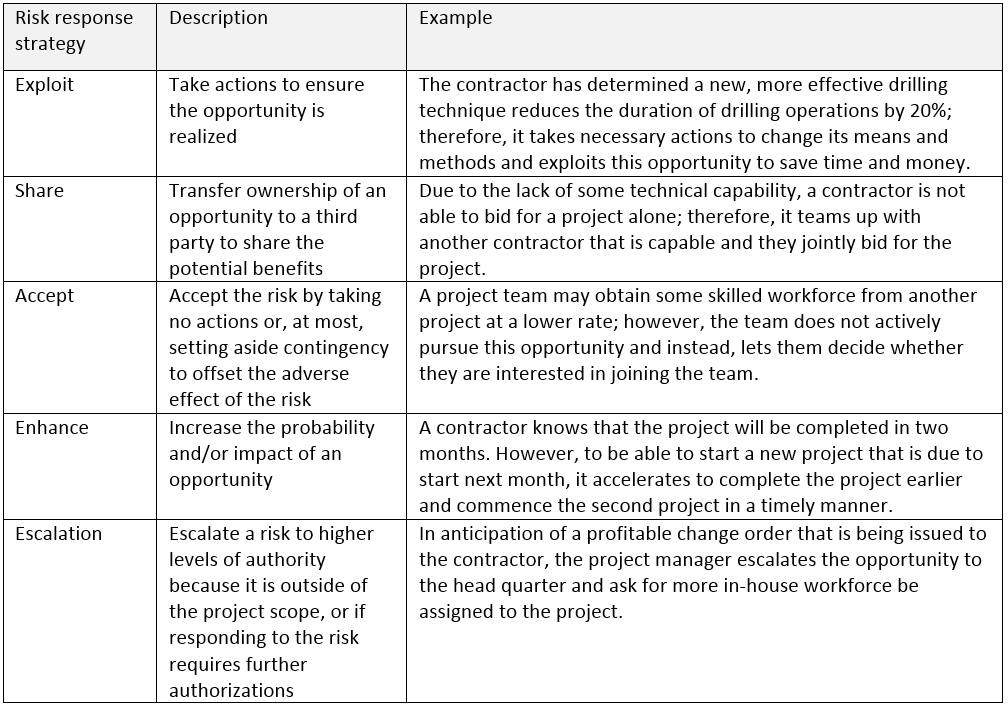
The PMBOK® Guide identifies the following as the five risk response strategies that can be used for managing positive project risks: exploiting, sharing, enhancing, escalation, and acceptance strategies (PMI, 2017). The following table provides a short description and example for each of these risk response strategies:

Table 2. Risk-response strategies for managing positive risks


Some of the common mistakes concerning project risks and risk response strategies include the following:

1- Risks are always negative: In fact, not all risks are negative. Although the word risk may have a negative connotation in conversations, risks are not always negative in project management. Risk is “any uncertain event or condition that, if it occurs, has a positive or negative effect on a project’s objectives” (PMI, 2017, p. 720). As such, risks may be negative (i.e., threats) or positive (i.e., opportunities).

2- All risks need to be mitigated: In fact, not all risks need to be mitigated. First, it is important to note that mitigating is a risks response strategy only for treating negative risks. This risk response strategy is not applicable to positive risks or opportunities. In addition, although risk mitigation is one of the main risk response strategies for treating negative risks, mitigation is not the only risk response strategy that can be used for treating negative risks. As shown in Table 1– Risk-response strategies for managing negative risks– aside from mitigation, four other risk response strategies also exist that may be used in response to negative risks.

3- Risks can be certain events or conditions: In fact, certain events or conditions for which no doubt or uncertainty exists should not be treated as risks. Definite, certain events are facts, not risks. For example, in case of “having inadequate time to complete the project”, if it is known that the time needed to complete the project is inadequate, this is not a project risk, instead, it is a fact. If uncertainty is not associated with an event or condition, it cannot be considered a risk anymore. To differentiate project risks from facts and to properly name project risks, it is recommended that project management practitioners always use the cause-risk- effect format to define risks. This format can be used as follows: [uncertain event or condition] may occur due to [the cause] which may result in [the effect]. Here is an example: The contractor may incur damages due to unforeseen site conditions which may result in project delays or disputes.

4- Other mistakes: The above-mentioned mistakes were some of the key mistakes made in defining risks or risk response strategies. However, other mistakes may also be made. Some examples include not accounting for contingency reserves or devising contingency plans as part of risk response plans, not assigning role and responsibilities in managing project risks, and not treating risk management as an ongoing process that needs to be performed throughout the project lifecycle.

In sum, many mistakes are made in defining project risks and identifying risk response strategies; however, the main ones include treating all project risks as negative events or conditions with an adverse effect on the project, treating mitigation as the only risk response strategy that can be imagined, and treating definite events or conditions as risks. A proper understanding of project risks and the strategies that can be used to manage project risks is necessary to ensure risks can successfully be managed. If project risks are left unmanaged, they have the potential to force the project to deviate from its plans or fail to reach its objectives.

Reference:

Project Management Institute [PMI]. (2017). A Guide to the Project Management Body of Knowledge (PMBOK ® Guide) (6th ed.). Newton Square, PA: PMI Publications.

—

Our posts to the Insights page share fresh insights and seasoned advice about many project and construction management topics.  To have the Insights monthly newsletter delivered automatically to your email inbox, please subscribe here.

Changes that arise from design-related causes

Dr. Maryam Mirhadi, PMP, PSP

Contract documents for a construction project consist primarily of the agreement, conditions of the contract, drawings and specifications, and any addenda issued to clarify, or modify the bidding or proposal documents before the contract for construction is signed. As such, construction drawings and specifications are parts of the legal documents of the agreement that are issued to delineate the requirements regarding the materials, products, systems, installation guidelines and procedures, standards and workmanship, and quality aspects involved with the execution of the work. This short article identifies some of the design-related factors that may result in change orders.

Defective specifications are examples of design-related issues that may result in contract modifications. An owner may specifically direct a contractor to make changes to the contract scope of work if it finds out that the specifications are defective. It is more likely, however, that defective specifications result in constructive changes. Incomplete or inaccurate specifications are examples of defective specifications.

Here are examples of changes that may occur due to design-related reasons:

Changes due to incomplete specifications: If specifications provide insufficient information necessary to implement the work outlined in the contract, they are considered incomplete. In addition, if specifications provide inadequate information in coordinating construction details between different design disciplines (e.g., structural, mechanical, electrical), specifications are considered incomplete. A complete set of specifications are intended to provide adequate information necessary to execute the work to achieve the project objectives set forth in the contract.

Changes due to design discrepancies: If the construction drawings associated with different trades are inconsistent, a design discrepancy exists between contract documents. In addition, differences and discrepancies among plans, specifications, and details or discrepancies between planned and actual equipment details may be indicative of design discrepancies that need to be rectified by issuing proper change orders.

Changes due to physical or technological constraints: Specifications may also be considered defective if a project design does not provide adequate space for fitting all the elements or does not meet physical or technological constraints that need to be considered in design and construction. Depending on the level of complexity of the issue, site conditions, and other technical and contractual requirements, resolving such issues may require changes in design, modification of requirements, and subsequently making minor or major adjustments on-site where appropriate.

Changes to satisfy regulatory requirements. Design documents are supposed to satisfy the requirements of applicable codes, standards, and regulations. Therefore, if the project team finds out that the project scope of work needs to be modified to properly satisfy regulatory requirements, a change order may be needed to ensure the requested change is properly reflected on design documents and implemented to satisfy regulatory requirements.

Latent conditions: Some changes are made due to differing site or subsurface conditions, unknown at the time of bidding. They are conditions within the project site that are materially different from what was shown on the contract documents or those that substantially differ from conditions that are obvious and apparent.

Other changes that occur due to design-related reasons may include changes due to a change in needs and expectations, changes made to address value engineering concerns, and modifications due to technology-related needs, and those due to errors and omissions. It is important to identify, properly document, and control changes over the course of projects to ensure project scope is managed in an effective manner, and to ensure time and cost overruns arisen from scope-related issues are minimized.

—

Our posts to the Insights page share fresh insights and seasoned advice about many project and construction management topics.  To have the Insights monthly newsletter delivered automatically to your email inbox, please subscribe here.

Adverse effects of shiftwork on labor productivity

Dr. Maryam Mirhadi, PMP, PSP

One of the factors with adverse effects on labor productivity is shiftwork. Shiftwork is defined as working other than regular daytime hours. Shiftwork is the most commonly utilized alternative to overtime; however, these two methods may be used together so that segregating the two may not be straightforward. It is also important to note that overtime and shiftwork adversely influence productivity in a generally similar way.

When work is performed on a shiftwork basis, labor productivity is adversely affected because of reasons such as stress on circadian rhythms, additional resource or preparation needs, or other factors such as additional coordination, labor, and supervision. These factors need to be considered when work on a shiftwork is scheduled to ensure informed decisions are made.

One of the key issues with shiftwork is its adverse effect on circadian rhythms. Circadian rhythms are the approximate 24-hour variations in bodily functions in individuals. The key cyclic changes that occur in bodily functions in individuals include sleep patterns, blood pressure, heart rate, and core body temperature. Bodily functions tend to increase right after awakening, increase in midafternoon, and then steadily decrease in the middle of the night. As such, those who need to perform on a shiftwork basis typically experience a degradation in performance.

Although the body of those individuals who perform on a shiftwork basis tend to adapt to night work, the circadian rhythm does not in fact completely shift and bodily adjustment periods tend to be long. Some indications that may suggest shiftwork has adversely affected an individual’s body include higher rates of accidents and error in performing tasks, fatigue, appetite loss, increased sickness rates, digestive problems, and other health problems.

Consequences of shiftwork are not limited to those effects that adversely affect the circadian rhythms of individuals who perform on a shiftwork basis. Other issues with shiftwork include the following:

1- The adverse effects of shiftwork on social interactions and negative effects on family life of those who perform on a shiftwork basis.

2- Dilution of supervision typically occur as a result of shiftwork because the supervising team may not use the same working pattern than the working pattern used by shift-working individuals.

3- Challenges in exchanging performance information among individuals who work in different shifts.

4- Higher work setup times. Different shift-working teams tend to work with the same set of tools, machinery, and equipment; therefore, work setup times are typically higher when multiple teams (instead of one team) use the same set of tools, machinery, and equipment. In addition, extra time is needed in shiftwork for the process of hand-over and transition from one shift to another.

5- Work environment considerations: Since shiftwork is performed in hours other than daytime hours, work environment considerations need to be identified. Examples include natural lighting vs. artificial lighting and additional demands for air conditioning.

All of the above-mentioned factors adversely influence work performance in performing tasks that are implemented on a shiftwork basis. Moreover, successful implementation of the work that needs to be performed on a shiftwork basis typically requires additional resources to accommodate the shift project. Additional resources that are generally needed to support shiftwork can be categorized into the three main categories of labor, supervision and job-specific costs. Each of these categories are further discussed in the following:

1- Labor needs

Shiftwork typically requires hiring of additional personnel; however, it is important to note that, because of the learning curve effect, the efficiency level of new hires are typically lower than the efficiency of the current team members. In addition, employers need to pay for shift premium differentials, as needed. Other labor-related considerations that need to be given to shift-working include long bodily adjustment periods, especially for those individuals who are not used to shift-working, higher accident and error rates in performing shiftwork, higher likelihood of improper alcohol consumption before or during shiftwork, and poor attitude towards shiftwork.

2- Supervision needs

Adequate supporting and supervisory personnel are needed when a work is performed on a shiftwork basis. Establishing relationship between work shifts and proper hand-over process between shifts are also important to ensure the work smoothly progresses across different work shifts.

3- Job-specific needs

Examples job-specific needs that have to be evaluated include safety requirements, higher demands for air conditioning or heat equipment to perform shiftwork, and adequacy of equipment, tool, machinery, and material to ensure enough resources are available on-site to make progress as expected.

A number of studies address the adverse effects of shiftwork on productivity. Some of the key studies include the Bureau of Labor Statistics, the Business Roundtable, NECA 1969 study, and the Construction Industry Institute (CII). The American Association for Cost Engineering (AACE) has identified some of the recommended specialized studies that can be used to evaluate the adverse effects of shiftwork on productivity (AACE, 2004). AACE categorizes the specialized studies related to overtime and shiftwork into the same category because these two areas overlap and the adverse effects of overtime and shiftwork on productivity are similar

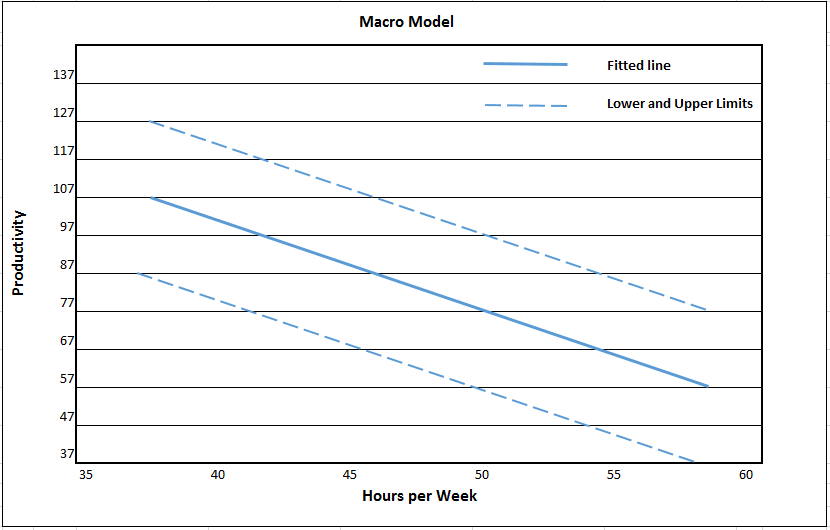
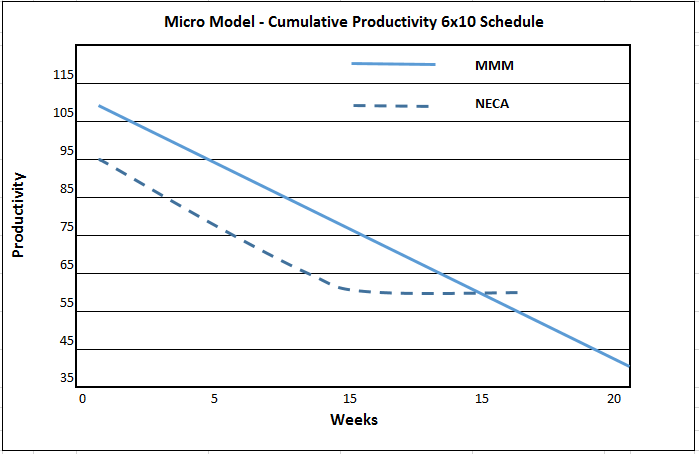
One set of models that are often used to assess the adverse impact of shiftwork and/or working overtime on labor productivity is the work of Hanna and Haddad (2009), which is a modified version of the NECA study.  The work of Hanna and Haddad (2009) proposes using macro and micro approaches. The macro approach is used for projects in which no specific overtime schedule is used whereas the micro approach is used in projects in which a fixed overtime schedule (e.g., such as six 10 hour days per week throughout a certain number of weeks) is utilized. Both models indicate that as the number of weekly hours worked increase, the labor productivity declines. The following two figures illustrate these two models:

.

(Adapted from the work of Hanna and Haddad (2009))

In Figure 1 a regression line is fitted to the data which plots the performance factor index (i.e., earned hours / actual hours) against the total hours worked per week. Figure 2 plots productivity against the number of weeks in which a fixed overtime schedule (e.g., such as six 10 hour days per week throughout a certain number of weeks) is utilized. Since this model uses Measured Mile Method (MMM) to calculate productivity loss in periods with and without overtime, the outcomes of the model are shown as MMM. These outcomes are compared against the NECA 1969 study.

In sum, shiftwork is one of the methods that are used to accelerate projects. It is important to note, however, that, similar to working overtime, shiftwork has adverse effects on labor productivity. Some of the key issues with shiftwork include its adverse effect on circadian rhythms, dilution of supervision, challenges in exchanging performance information among individuals who work in different shifts, the adverse effects of shiftwork on social interactions, and higher work setup times. The methods used to assess the adverse effects of shiftwork on productivity overlap with the methods used to evaluate the loss of labor productivity due to overtime because the adverse effects of overtime and shiftwork on productivity are similar.

References:

AACE International (2004), Recommended Practice 25R-03 Estimating Lost Labor Productivity in Construction Claims, AACE International, Morgantown, WV.

Hanna, A. S., & Haddad, G. (2009). Overtime and productivity in electrical construction. In Construction Research Congress 2009: Building a Sustainable Future (pp. 171-180).

—

Our posts to the Insights page share fresh insights and seasoned advice about many project and construction management topics.  To have the Insights monthly newsletter delivered automatically to your email inbox, please subscribe here.

Adroit obtained the WBE Certificate from the State of New Jersey

In March 2018, Adroit obtained the WBE Certificate from the State of New Jersey, the Division of Minority and Women Business Development in the Department of the Treasury. As a result, Adroit will be engaging more in state-funded projects being undertaken in the State of New Jersey with defined Women Business Enterprises (WBE) goals. Please contact us if you are looking for a WBE-certified project management consultant.

The WBE certificate is designed to promote equality of economic opportunities for MWBEs and to eliminate barriers to their participation in state contracts. An important objective of the program is to:

  • Encourage and assist state agencies to award a fair share of contracts to MWBEs.
  • Review applications by businesses seeking certification and maintain a directory of certified MWBEs.
  • Promote the business development of MWBEs through education and outreach to NYS agencies as well as MWBEs.

For more information, please contact the Division of Minority and Women Business Development at:

Division of Revenue

Business Support Services Bureau

P.O. Box 455

Trenton, NJ 08646

http://www.nj.gov/njbusiness/contracting/

http://www.nj.gov/njbusiness/documents/contracting/NEW%20MBE-WBE%20%20Web%20Application%20JAN_2012.pdf